Cartier
A Paris jeweller who designed a wristwatch for an aviator in 1904, and fifteen years later drew the Tank after the tanks on the Western Front of the First World War.
Service, repair and re-gilding of your Cartier
Cartiers come into the workshop very regularly, and most of the time it's a Tank: large or small, hand-wound or quartz. The Santos, the Pasha and the Carrée come by as well.
A large share of them are vermeil: the Must de Cartier watches, with a silver case and a layer of gold over it. After years of wear that gold layer rubs off, especially on the corners and edges. The case is then re-gilded: first a base layer, then the gold.
A damaged crystal is common too; a new crystal is then bonded in with glue that cures under UV light. Beyond that it's usually a service, or a new battery.
Whether you send your Cartier in or bring it by, you always get a quote first; the work only starts once you've agreed, in the workshop in Weesp. You can see how a vermeil Cartier is restored here in the video on the Restoration page.
History
In 1847 Louis-François Cartier took over the Paris workshop of his master, Adolphe Picard. His son Alfred took over the business in 1874, but it was Alfred's three sons who made it a name known worldwide: Louis in Paris, Pierre in New York and Jacques in London.
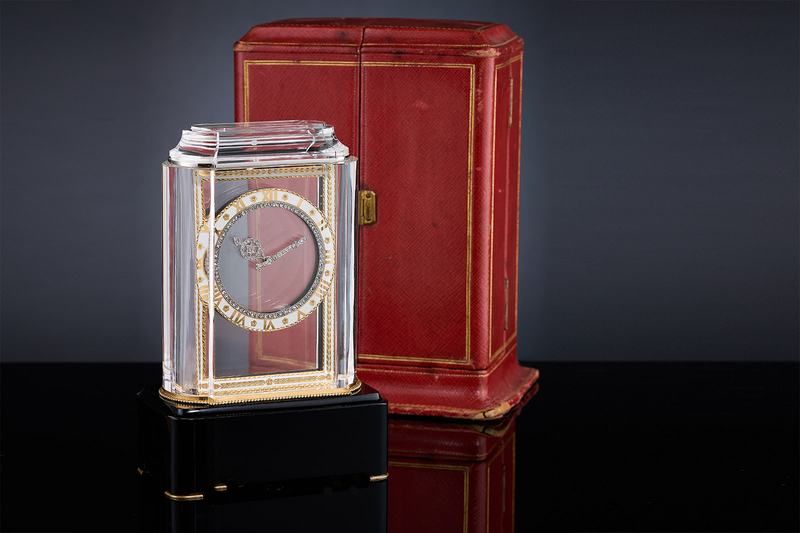
Louis moved to the Rue de la Paix in 1899 and there designed much of what made Cartier famous, from the 'mystery clocks' — clocks with a transparent dial whose movement stays hidden — to the colourful Tutti Frutti jewellery. He was also one of the first to use platinum in jewellery.
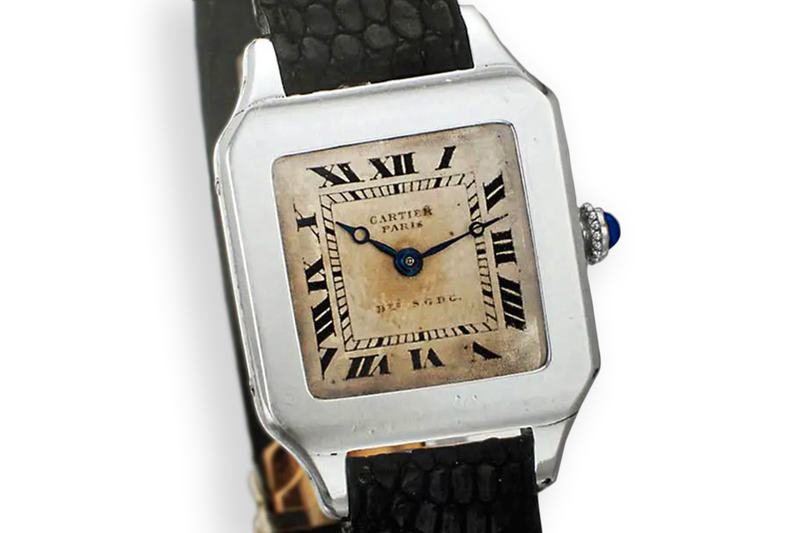
The wristwatch came by way of a friend. In 1904 the Brazilian aviation pioneer Alberto Santos-Dumont complained to Louis that a pocket watch was awkward and unreliable in the air. Cartier designed him a flat wristwatch with a square bezel: the Santos, the house's first men's wristwatch, and the only one named after its first wearer. From 1907 Edmond Jaeger supplied the movements.
The Tank followed in 1919, designed by Louis after the tanks that had appeared on the Western Front shortly before. In the 1920s Cartier and Jaeger set up a company that made movements for Cartier alone, but the house went on using other makers' movements too: Vacheron Constantin, Audemars Piguet, Movado and LeCoultre.
After Pierre's death in 1964 the family sold the three branches. A group of investors around Robert Hocq and Joseph Kanoui bought them back between 1972 and 1976 and brought Cartier together again. Hocq came up with the name 'Les Must de Cartier', and in 1976 that became a separate, more accessible line of the house. By 2012 Cartier was, through Richemont, owned by the South African Rupert family.