Omega
From a one-man business in 1848 to one of the largest watch factories in Switzerland. A brand with a rich history full of horological innovations.
Service and repair of your Omega
Vintage Omegas are serviced regularly in the workshop in Weesp: Seamasters, Constellations and Speedmasters.
The movements we open most often are the automatics of the 55x and 56x families — calibres 551, 552, 561, 562, 564 and 565 — and the later calibre 1481. Bumper automatics from the 1950s, such as the 354, and hand-wound movements like the 283, 600, 613 and 625 come by too. Chronographs such as calibre 861 and the later 1152 are regularly on the bench as well.
Usually it's a complete service: the movement is completely disassembled, cleaned, lubricated and regulated, and the case gets new gaskets. Often a new crystal goes in at the same time and the case is cleaned ultrasonically.
Everything is done in the workshop; nothing goes to a service centre. The watch is opened first and you get a quote by email — we only start once you've agreed. A service comes with a two-year guarantee. You can see how the crystal of a Seamaster Cosmic 2000 is replaced on the Repair page.
History
In 1848 Louis Brandt began assembling precise pocket watches in La Chaux-de-Fonds, from parts he bought from craftsmen in the area. He sold them from Italy to Scandinavia, but his most important market was England.
Things only really took off when his sons, Louis-Paul and César, devised a way of producing in 1894 that kept everything in their own hands and made the parts interchangeable. The watch that came out of it was named Omega, and that name proved so much stronger than the company's that in 1903 the company simply took the watch's name.
Both brothers died that same year. They left one of the largest watch factories in Switzerland to four young heirs, the eldest of whom, Paul-Emile Brandt, was not yet twenty-four. He took Omega through the difficult years after the First World War and brought it together with Tissot; in 1930 they merged into the SSIH group, which eventually took in some fifty companies, among them Lemania, the maker of Omega's most famous chronograph movements.
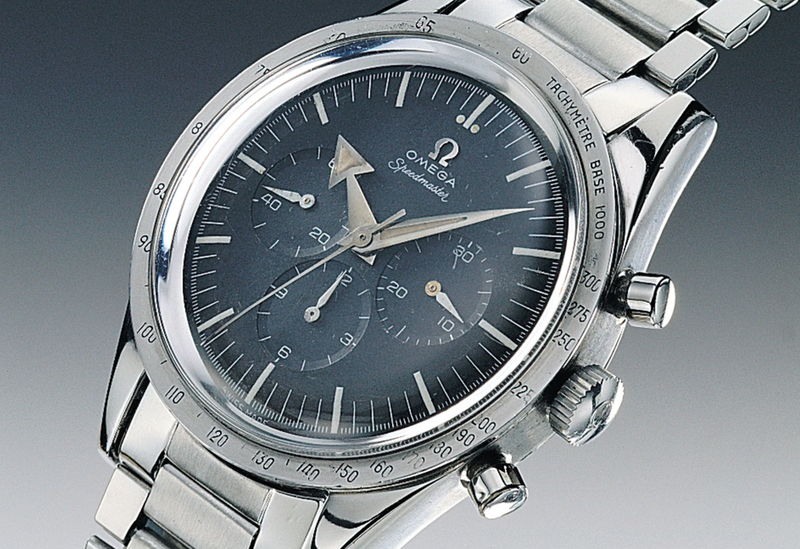
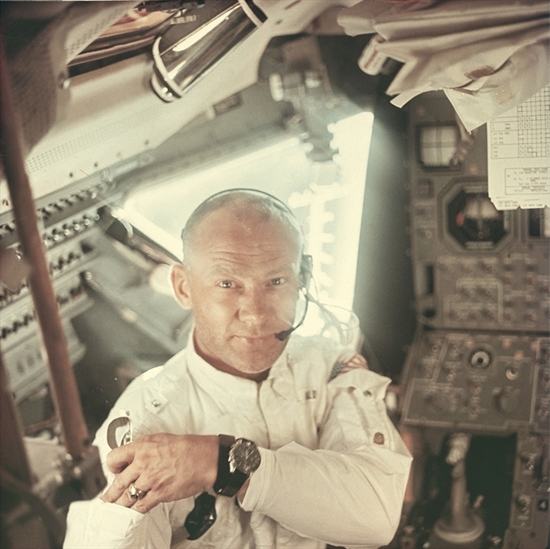
That tie with Lemania also produced the watch Omega is most associated with. The Speedmaster appeared in 1957 as a chronograph for racing drivers, with the tachymeter scale on the bezel rather than on the dial and the hand-wound calibre 321 inside. When NASA put chronographs from several brands through a series of punishing tests in 1964 and 1965, the Speedmaster was the only one to pass them all and was approved for crewed spaceflight; Ed White wore it that year on the first American spacewalk. On 21 July 1969 Buzz Aldrin stepped onto the moon with a Speedmaster on his wrist; Neil Armstrong had left his in the lunar module as a backup. It has been called the Moonwatch ever since.
In the 1970s SSIH was the largest watch producer in Switzerland and the third largest in the world, and Omega sold more watches than Rolex. The difference between the two lay in their nature: Omega was the innovator with an eye for the craftsman, Rolex the more conservative. When the quartz crisis came, Rolex held on to its mechanical chronometers and Omega tried to beat the Japanese on their own ground.
It ended badly: in 1981 the banks had to step in. What followed was the great restructuring of the Swiss watch industry, with a group of investors led by Nicolas Hayek, and eventually the Swatch Group. Omega climbed back, not least because in 1995 James Bond traded his Rolex Submariner for a Seamaster Diver 300M.